|
|
| Uncle Dynamite
|
|
Main page / Bibliography / Uncle Dynamite
|
First published in UK: October 22 1948 by Herbert Jenkins, London
First published in US: December 3 1948 by Didier, New York
 Russian translation Russian translation
Russian text (265K)
It is avowed mission in life of Frederick Altamont Cornwallis, fifth Earl of Ickenham,
to spread sweetness and light come what may.
From boyhood his has been a gay and happy disposition, and in the autumn of his life he still
retains the fresh, unspoiled mental outlook of slightly inebriated undergraduate.
A keen matchmaker and intrepid impersonator, Lord Ickenham is in his element when at large
on a sweetness-and-light-spreading excursion. On this occasion the hapless object of his
benevolence are his love-lorn nephew, Reginald ('Pongo') Twistleton, and Pongo's former
crony, Bill Oakshot. Invariably a mixed blessing, this time the gleam in Uncle Dynamite's eye
heralds trouble of a major kind...
|
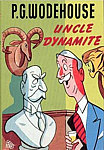
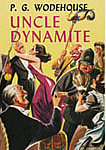
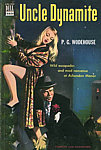
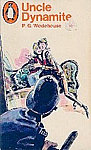

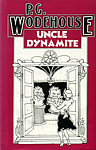
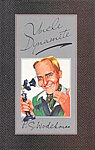
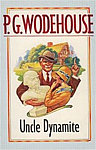
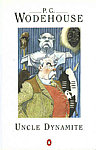
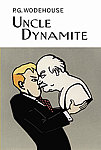
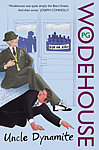
Click for enlarge book cover
|
|
Characters
Frederick Altamont Cornwallis, 5th Earl of Ickenham — 60 year old uncle of
Pongo's who went to school with Sir Aylmer and Major Plank and was known
there as Barmy. Wants Pongo to marry Sally.
Bill Oakshott — Childhood pal of Pongo's who is shy and loves Hermione
(Pongo) Reginald G. Twistleton — Lord I's nephew who inherited a pile of
money and is engaged to Hermione
(Mugsy) Sir Aylmer Bostock — Bill's 57 year old uncle, an ex-colonial
governor who is running for Parliament
Hermione Bostock — Sir Aylmer's determined, intellectual
daughter whom Bill loves with silent devotion. Engaged to
Pongo and writes novels under the name of Gwynneth Gould
(Bimbo) Major Brabazon-Plank — Lead an expedition to the Lower Amazon which
included Bill
Coggs — Lord Ickenham's butler
Sally Painter — Small, pert American sculptress who used to be
engaged to Pongo and loves him still
Otis Painter — Sally's brother who published Sir Aylmer's reminiscences
Lady Emily Bostock — Sir Aylmer's devoted wife
Harold Potter — 28 year old Police Constable engaged to Elsie.
Before being transferred to Ashenden Oakshott, he had
arrested Pongo and Uncle Fred at the Dog Races in London.
Elsie Bean — Housemaid at the Manor engaged to Harold
Mrs. Gooch — Cook at the Manor
Mrs. Bella Stubbs — Harold's 33 year old sister
Jno. Humphrey — Landlord of the Bull's Head
Erbut (*)
Augustus Popgood (*)
Cyril Grooly (*)
Jane (*)
Myrtle (*)
Percy (*)
|
 Synopsis Synopsis
Dark Gaming Ip |verified| -
In the sprawling ecosystem of interactive entertainment, light is easy to sell. Heroic journeys, moral clarity, and the dopamine rush of triumph form the backbone of the mainstream market. Yet, lurking in the peripheral vision of the industry—and increasingly seizing the spotlight—is the Dark Gaming IP . This is not merely a game with a night-time level or a villain with a tragic monologue. It is a gravitational field of thematic dread, aesthetic decay, and psychological unease. To create a lasting Dark IP is to build a cathedral of shadows where players come not to feel powerful, but to feel haunted . I. The Core Pillars of Darkness A successful dark IP cannot be dark solely by palette. It requires foundational pillars that permeate every asset, line of code, and note of music. 1. Existential Stakes (Not Just Survival) In a standard action game, the stake is death. In a dark IP, the stake is erosion . The protagonist does not simply risk losing a fight; they risk losing their identity, their sanity, or their understanding of reality. Games like Silent Hill 2 or Hellblade: Senua’s Sacrifice understand this. The monster is not the final boss; the monster is the protagonist’s own fractured psyche given teeth. A dark IP asks: What if winning costs everything you are? 2. Aesthetic Decay & The Grotesque Baroque Visually, the dark IP rejects sleekness. It embraces the Baroque of Ruin : gothic cathedrals bleeding into industrial sludge, bioluminescent fungi growing on rusted medical equipment, flesh merged with cold steel. The art direction should make the player’s skin crawl not through gore alone, but through wrongness —architecture that defies gravity, textures that suggest things moving beneath the surface, and lighting that functions as a hostile character. Shadows don’t just hide enemies; they breathe. 3. Moral Muck (The Gray Swamp) Forget the Paragon/Renegade wheel. A true dark IP presents choices where every option is a violation of some code. There is no "lesser evil," only chosen damnation . The narrative punishes purity. The moment a player feels they are the hero, the IP should reveal that they have been watering the roots of a catastrophe. The lore must be written such that even the angels (if they exist) are bureaucratic, indifferent, or carnivorous. 4. Sonic Dread Architecture Audio is the invisible knife. A dark gaming IP requires a soundscape of negative space . Not constant orchestral stings, but the groan of settling metal, the wet rhythm of a distant heartbeat, whispers that are just below the threshold of language, and silence that feels heavy. The score should be modal, atonal, or industrial—melodies that resolve incorrectly, leaving the player’s brain in a state of perpetual cognitive dissonance. II. Worldbuilding: The Cradle of Nightmares To own the "IP" label, the darkness must be systematic. It cannot be random.
The ultimate dark IP will not have a fixed script. It will be a mirror. It will build its nightmare around the unique architecture of your own psychology. It will be a game you play once, because after the credits roll, you will not be sure if the game has stopped playing you . To craft a dark gaming IP is to commit to a long, cold night. It is a rejection of the power fantasy in favor of the endurance nightmare . It is for audiences who want to look into the abyss not to conquer it, but to see what looks back. And if done right—with aesthetic integrity, mechanical purpose, and narrative courage—that abyss will look back with the wide, devoted eyes of a cult following that will never, ever let it die. dark gaming ip |
|

 Russian |
Forum |
Contact Us
Russian |
Forum |
Contact Us