


Oracle can be complex; however, your ERP data doesn’t have to be.

By combining the power of Oracle and Microsoft Excel, these suites of products enable you to keep control of your company's data.

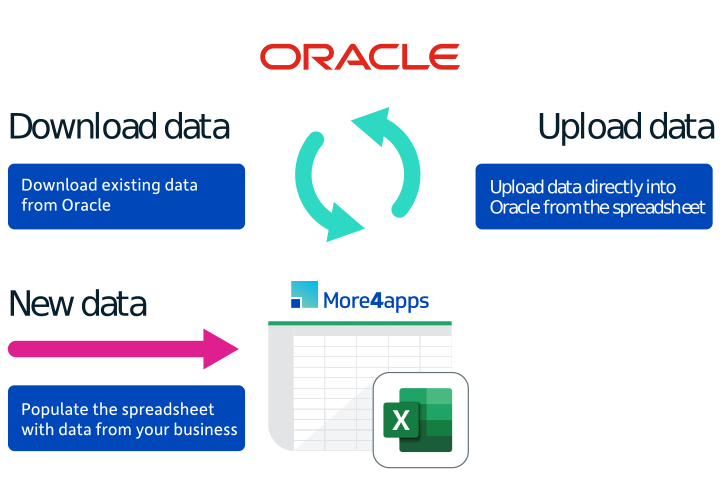
Create, update, and mass upload your pre-validated data into Oracle using the flexibility and familiarity of an Excel spreadsheet.
Ensure your business’s data integrity with the More4apps Toolbox suite of solutions for EBS and Cloud.
Our tools integrate seamlessly with each other and your Oracle ERP instance to provide you with up-to-date data when and where you need it and with the highest level of quality.
How does More4apps stack up to Oracle tools?


The “black hole” element intensifies this. It turns the browser into a cosmic drama. The user watches familiar icons—the colorful Google logo, the magnifying glass—spiral toward oblivion. It is a simulation of entropy. And yet, a simple page refresh restores everything to perfection. There is no real destruction, only play.
What sets Mr. Doob apart is his ability to blend technical sophistication with childlike wonder. Google Gravity is not a productivity tool; it is a . It asks no practical question other than: What if the internet fell apart? By making the most visited webpage on Earth suddenly obey physics, Mr. Doob humanizes the machine. He reminds us that behind every clean, rigid interface is code that can be rewritten, bent, and broken for fun. The Deeper Meaning: Control, Chaos, and Catharsis Why has Google Gravity remained popular for over a decade? Because it offers a rare form of digital catharsis . In our daily lives, we expect computers to be perfectly predictable. Links should not slide away; buttons should not bounce. Google Gravity violates that expectation in the most harmless, hilarious way possible. google gravity black hole mr doob
Next time you feel the weight of perfect, sterile interfaces, visit mrdoob.com. Let Google fall apart. Let the black hole swallow the search bar. And remember: sometimes, the most profound thing you can do with a tool is to lovingly break it. The “black hole” element intensifies this
In Mr. Doob’s simulation, the “black hole” is a metaphor . The center of the screen (or the bottom, depending on the version) acts as a gravitational well. When you enable certain versions of the experiment, a visible black hole appears, pulling all the page elements into its vortex, stretching and distorting them before they disappear. Even without the explicit graphic, the feeling is the same: an orderly system (Google’s clean, minimalist homepage) is suddenly overwhelmed by an invisible, irresistible force. The user is no longer a passive searcher but a playful god, tossing the fragments of the interface into the abyss. It is a simulation of entropy
The search bar, the logo, the buttons, and the text links suddenly succumb to a simulated gravitational field. They tumble downward, pile up at the bottom of the screen, bounce off each other, and can be clicked, dragged, and thrown around the window like debris in zero gravity that has suddenly found a floor. The page is no longer a static interface; it has become a sandbox governed by Newtonian physics—mass, velocity, friction, and restitution.
This juxtaposition is powerful. On one side, we have Google: the ultimate tool of digital order, indexing the world’s information. On the other, we have Mr. Doob’s gravity: the force of chaos, randomness, and play. The black hole represents the ultimate loss of control—but in a safe, reversible, browser-based environment. Mr. Doob (Ricardo Cabello) is a key figure in the creative coding movement, particularly known for his work with Three.js , a JavaScript library that makes WebGL (3D graphics in the browser) accessible. His portfolio (mrdoob.com) is a treasure trove of experiments: particle systems, 3D models, harmonic oscillators, and, most famously, Google Gravity.
Data is growing exponentially, leading to overwhelming volumes and inefficiencies. Oracle tools can be complex, leaving you with a time-consuming, burdensome process.
More4apps solutions for E-Business Suite and Fusion Cloud were purpose-built with end users in mind.
Quickly and easily download them from the More4apps Community!

Efficiency
Save time by downloading or pasting data into the Excel spreadsheet for Oracle.
Productivity
Simple business process changes coupled with intelligent More4apps spreadsheets delivers significant productivity gains.
Quick to Implement
Tools that work straight out of the box with a familiar Excel user interface.
Accuracy
Less manual data entry means better accuracy and more meaningful information for your business.
Security
Products are built specifically for ERP leveraging Oracle's existing security measures.
Ongoing Support
A class-leading support team that solve issues and manage requests in record time.From assisting you during the trial period to continuous use of the suite of products, More4apps offers global support and an online Community, which provides access to customer resources, training materials, and interactive knowledge boards.

Connect with an expert
